
Same Capacity, Different Runtimes: Why Idle Draw is the Spec Most People Overlook
Hurricane season is here, and with NOAA forecasting an above-normal 2026 Central Pacific season, a lot of us are thinking through the basics: water, meds, flashlights… and yeah, the fridge.
In our recent Better Together Podcast episode feating HIEMA, we briefly touched on portable power stations as a no-gas, no-fumes option for fridge backup.
They're especially useful for people who can't install a whole-home battery or safely run a generator. If you live in a condo or townhome, you already know: a traditional generator usually isn't an option.
Here's the part we didn't get to unpack on the episode.
Same Capacity ≠ Same Runtime
Portable power stations can be more nuanced than they look at first glance. Even when two units advertise the same energy capacity (measured in watt-hours or kWh), they may power a fridge for very different lengths of time.
The reason? Idle draw, also called overhead or standby consumption. This is the energy the unit uses just to stay "awake" and deliver standard wall-outlet (AC) power, even when your fridge compressor isn't actively running.
Think of it like a car idling at a red light: the engine's burning gas even though you're not going anywhere. A power station's inverter, display screen, cooling fans, and internal circuitry all consume energy just by being switched on. That background drain adds up, and depending on the unit, it can chip away at your usable runtime by 10–30% or more.
How We Calculated Our Comparison
To keep things simple, the infographic below uses an "average French door fridge" baseline of 653 kWh/year — the average of three popular EnergyGuide® examples (633, 645, and 682 kWh/year). That works out to roughly 1.79 kWh/day.
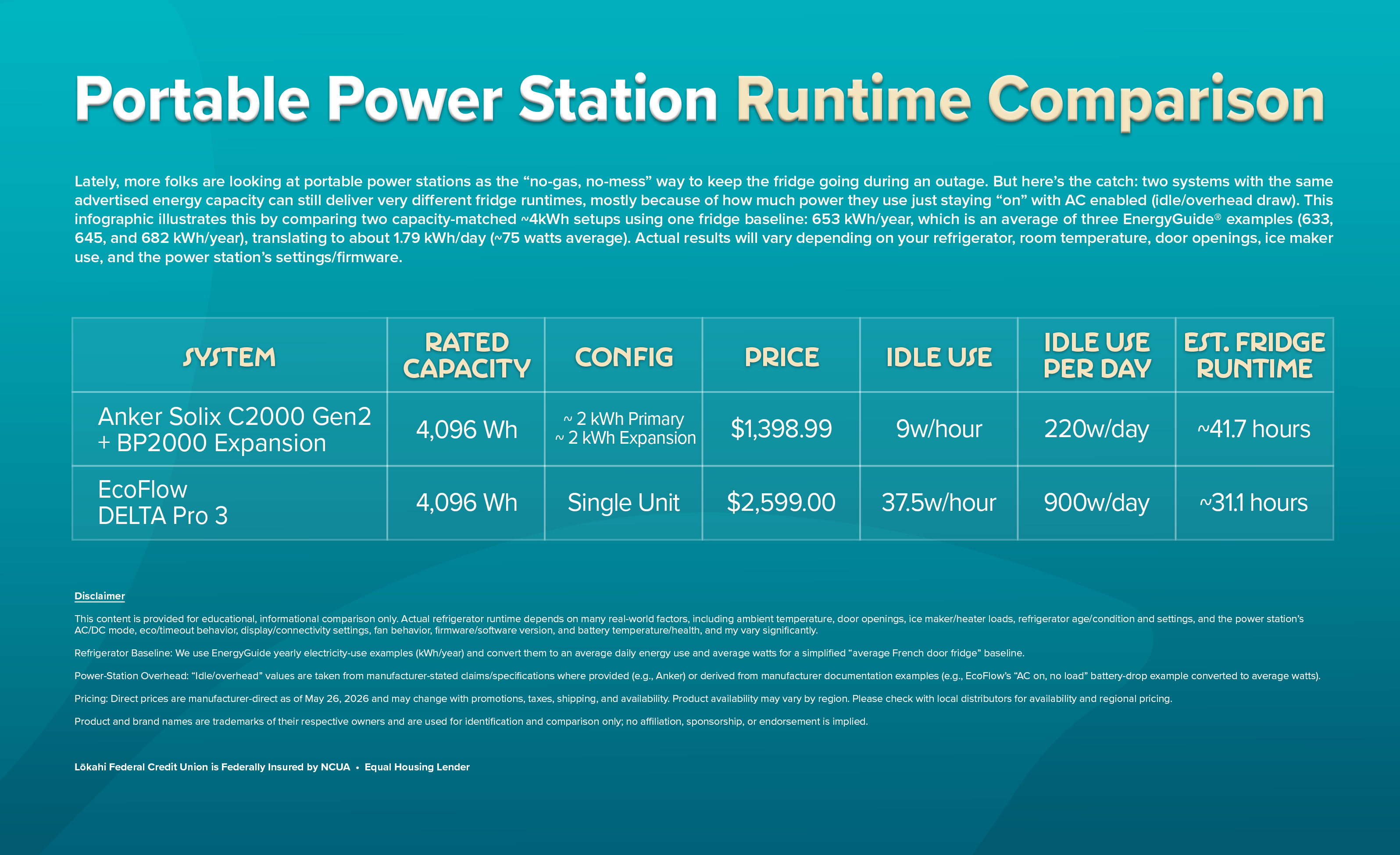
The takeaway: capacity alone doesn't tell the whole story. Two setups with the same battery size can give you meaningfully different hours of fridge backup, and idle draw is a big reason why.
What Else Should You Look For?
Idle draw is a big deal, but it's not the only spec worth checking before you invest. Things like surge wattage, auto-off settings, weight, and cord logistics matter just as much, especially during an actual outage.
We'll break all of that down in our next post, and cover other prep topics in the coming weeks. Keep an eye on your inbox and our Ready Together page for future installments!
Why This Year Matters
This isn't a "just in case" year. NOAA's 2026 Central Pacific outlook calls for 5–13 tropical cyclones (well above the average of 4–5), driven by developing El Niño conditions that warm Pacific waters and fuel more storm development. Peak activity for Hawaiʻi typically runs July through October, so the window to prepare is now.
Hurricane season prep looks different for everybody, the goal is just to make the next outage a little less stressful.
Ready to Take the Next Step?
If portable power (or PV + battery) is on your list and you're thinking about how to pay for it, we can help you explore what fits your budget. Stop by any branch or give us a call at 808.440.5830. We can talk story, walk through your options, and help you take the next step when you're ready.
Frequently Asked Questions
How long will a portable power station run my fridge?
It depends on three things: the station's usable capacity (kWh), your fridge's daily energy use, and the unit's idle draw. As a general guide, a 2 kWh station powering an average French door fridge (~1.79 kWh/day) could last roughly 18–26 hours, but high idle draw can cut that significantly.
What is idle draw on a portable power station?
Idle draw (also called overhead or standby consumption) is the energy a power station uses just to stay on — powering its inverter, display, cooling fans, and circuitry, even when no appliances are actively drawing power. It can reduce usable runtime by 10–30% or more.
Can I use a portable power station in a condo or apartment?
Yes, that's one of their biggest advantages. Unlike gas generators, portable power stations produce no exhaust, no fumes, and very little noise, making them safe for indoor use in condos, townhomes, and apartments where generators aren't allowed.
What size portable power station do I need for a fridge?
For a standard French door fridge, look for at least 1.5–2 kWh of capacity and make sure the inverter can handle compressor startup surge. We'll cover wattage and surge specs in more detail in our part 2.
Dislaimer
This post is provided for general informational purposes only and is not a substitute for official emergency instructions. Conditions and guidance can change quickly during an active event — always follow alerts and directions from hawaii.gov/hiema, your county emergency management agency, and other official channels.
Brand names and product models referenced in this post are used for illustrative and educational purposes only. Lōkahi Federal Credit Union is not affiliated with, sponsored by, or compensated by any of the manufacturers mentioned. Inclusion does not constitute an endorsement or recommendation. Features, specifications, and pricing may change without notice. Always verify details with the manufacturer or local distributor before purchasing.
The average fridge baseline of 653 kWh/year used in this post is derived from three EnergyGuide® examples (633, 645, and 682 kWh/year) and is for illustrative purposes only. Actual energy use varies by model, age, usage, and conditions. EnergyGuide® is a registered trademark of the Federal Trade Commission.
External links or resources are shared for convenience and do not imply endorsement.