If you've been following our disaster preparedness series, you know we've been covering practical ways to keep your household ready when the unexpected happens. Recently, we talked about why a portable power station (PPS) belongs in your emergency kit, especially if other options aren't practical or possible, such as backup gas generators or PV systems with whole-home battery systems.
But here's the thing, a PPS is only useful if it can actually power what you need, for as long as you need it. So before you spend a few hundred (or a few thousand) dollars, let's break down how to pick the right one.
Three Numbers. That's It.
1. Watts (W): "Can it run my stuff?" Think of watts like the size of a water pipe. Your PPS has a maximum flow, and if you try to push more through than it can handle, it shuts off. A power station with a 600W maximum output can't run a 1,500W microwave, no matter how big the battery capacity is.
2. Watt-hours (Wh): "How long will it last?" This is the size of the tank. A 1,000Wh battery powering a 500W load lasts roughly 1.5–2 hours (after efficiency loss). That same battery powering a 100W load? Around 8–9 hours. Bigger tank, longer runtime.
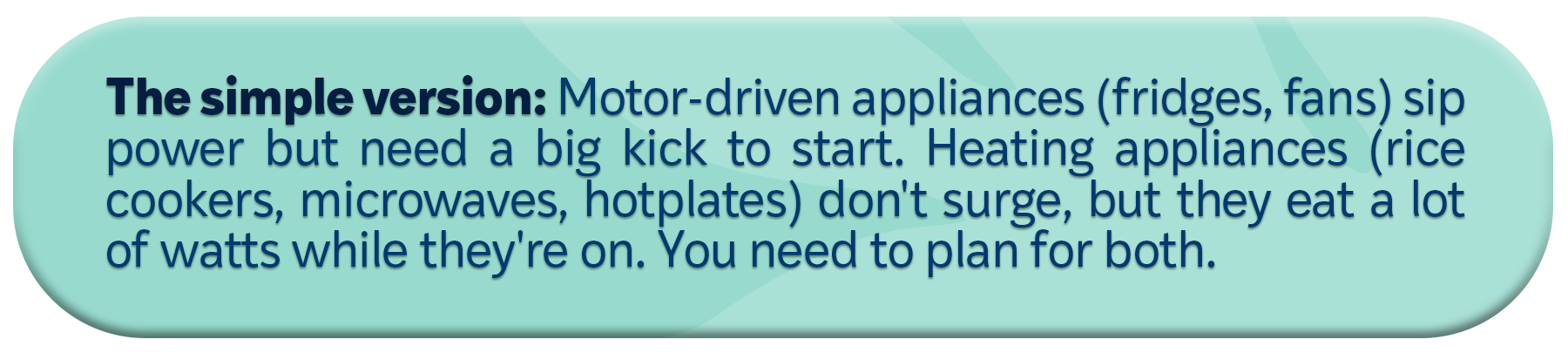
3. Surge Watts: "Can it start my fridge?" Here's where people get tripped up. Your fridge only uses about 150W while running, which is well within the capabilities of most units. But when the compressor kicks on, it needs a quick burst of around 1,200W for a second or two. If your PPS can't handle that spike, the fridge never starts, even if you have plenty of battery left.
One Thing People Miss About Surge
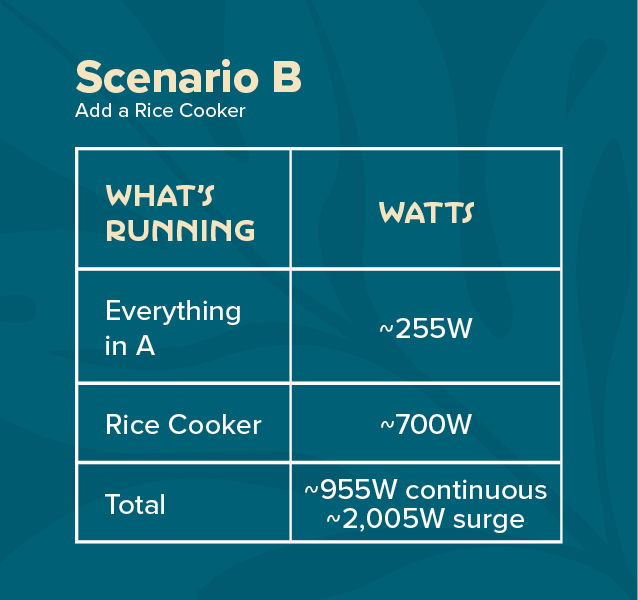
Your fridge compressor cycles on and off throughout the day. When it kicks on, it needs that ~1,200W burst on top of whatever else is already running. So if your rice cooker is humming along at 700W and your basics are pulling another 105W, the fridge surge pushes your total to ~2,005W for that second or two.
That means the more you have plugged in, the higher your PPS's surge rating needs to be, even though the surge itself doesn't change.
Common Appliance Wattage Reference
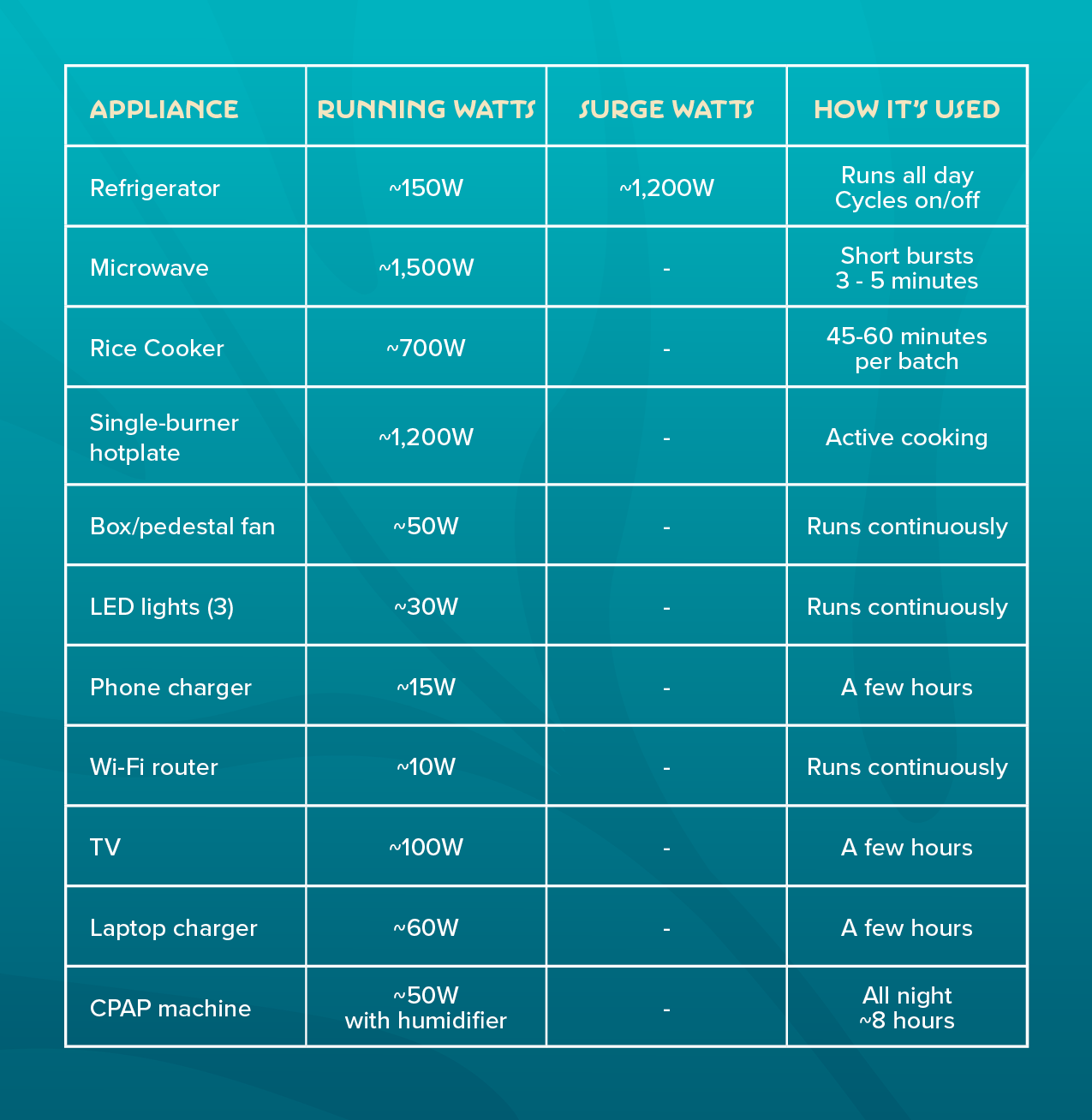
Here's what common household appliances actually draw:
Note: A microwave's advertised wattage (e.g., "1,000W") is its cooking output. The actual power it draws from the wall is higher, typically 1,200–1,500W. That's the number that matters for your PPS.
Putting It Together: Three Common Scenarios
To illustrate the power consumption data in the above table, we'll run through a few scenarios to show how much continuous output, surge output, and capacity your PPS needs to run several essentials.
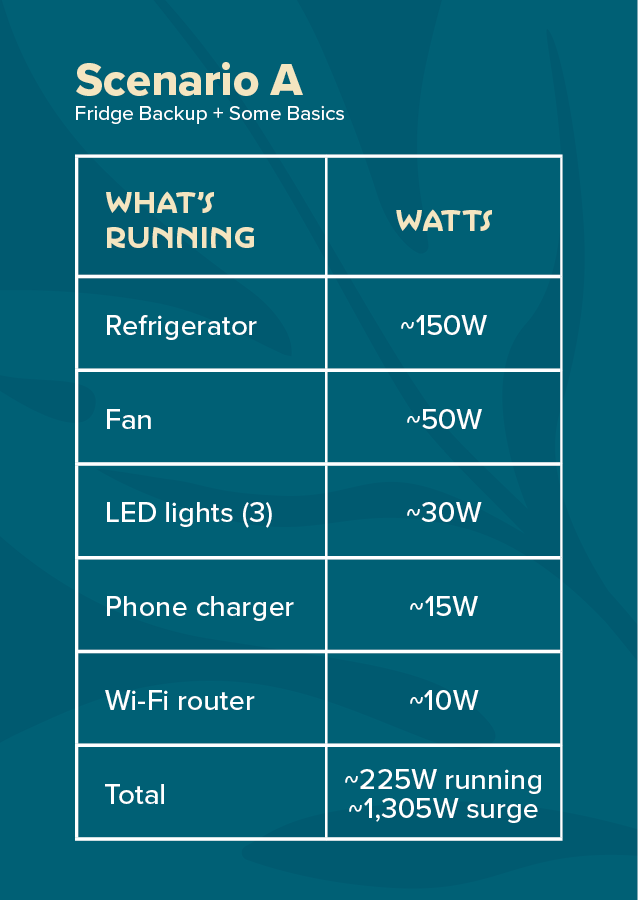
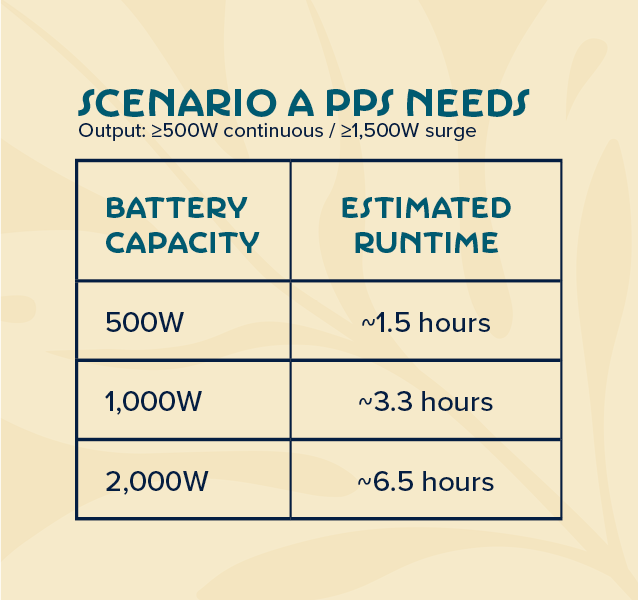
Scenario AIn this scenario, we're seeking to keep your perishables from spoiling, while keeping you cool and connected.
Scenario B
In this scenario, we keep all of the items from A, but also add a rice cooker. You know, in case you want some hot rice to go with some cold leftovers or a can of tuna with shoyu.
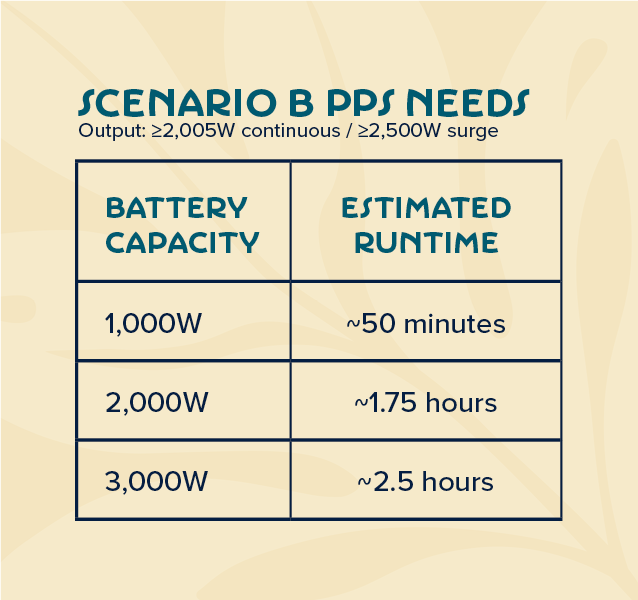
See that? A 1,000Wh battery gives you roughly 50 minutes at this load. Rice takes 45–60 minutes to cook. You're cutting it close, and once the rice is done, how much battery do you have left for the fridge?
Scenario C
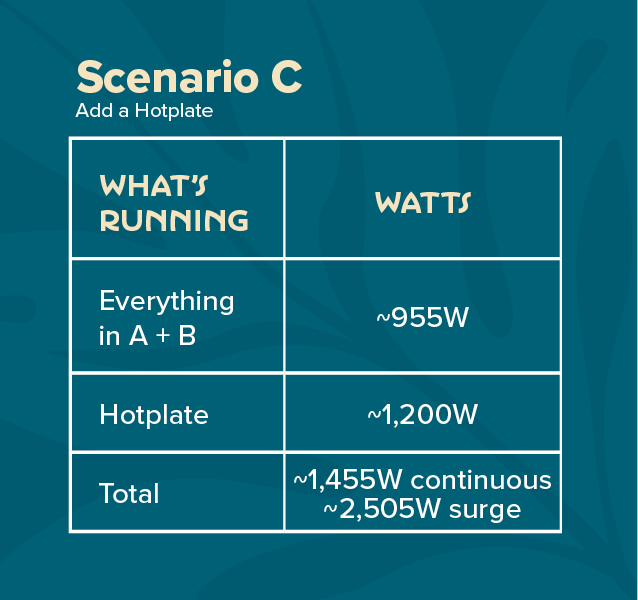
In this scenario, we keep everything from A + B, but add a hotplate. This is the Spam® Musubi scenario.
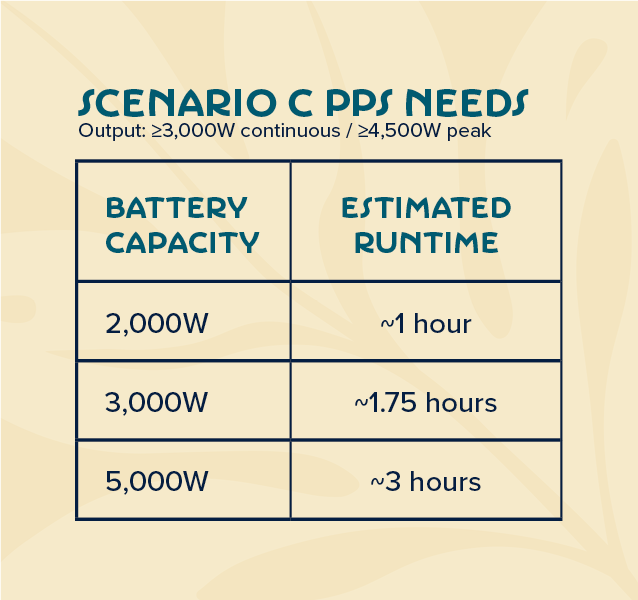
The moral of the story is, the more stuff you want to run, the more capacity and output you'll need - both continuous and peak. Of course, these are just straight numbers. If you refer back to our previous post, you can see that not all PPS are created equal. Two units could have identical capacities (Wh) but vastly different idle/parasitic draw, resulting in double-digit differences in overall runtime.
What About a CPAP?
If you or someone in your household uses a CPAP machine, this is especially important. A CPAP with a heated humidifier draws about 50–100W, not much, but it needs to run all night. At 8 hours, that's 400–800Wh just for the CPAP.
Add that to your fridge and basics (Scenario A), and you're looking at roughly 305–355W continuous and 1,000–1,500Wh per overnight session. A 1,000Wh power station might get you through one night, but just barely. A 2,000Wh unit gives you breathing room (literally).
A Note on Fridge Runtimes
One more thing: as we covered earlier and in our previous post, your fridge compressor doesn't run nonstop. It cycles on and off to maintain temperature, which means it averages closer to 50–80W over time rather than the full 150W. Our estimates above use the higher running wattage to be conservative, so your actual runtime for Scenario A will likely be longer than what's shown here. Think of it as a built-in safety margin.
The Real Takeaway: It's Not Just Watts or Watt-Hours. It's Both.
A power station with a big inverter (high watts) but a small battery (low Wh) is like a fire hose connected to a bucket. It can blast water—but not for long.
A power station with a huge battery but a small inverter is the opposite, a garden hose connected to a swimming pool. It'll run forever, but it can't power anything demanding.
You need the right pipe and the right tank for your situation.
How to Check Your Appliance's Wattage
Not sure how much power your stuff uses? Here are three ways to find out:
- Check the label. Look on the back, bottom, or inside the door of your appliance. It usually says something like "120V ~ 5.8A" or "700W."
- If it shows amps, multiply by 120. Example: 5.8A × 120V = ~700W. That's your rice cooker.
- Use a watt meter. A plug-in meter like the Kill-A-Watt (around $20–$30 at most hardware stores) gives you exact real-time and average draw. This is the most accurate method, especially for fridges that cycle on and off. Plug it between your fridge and the wall for 24 hours and you'll know exactly what you're working with—no guessing.
A Few Tips Before You Shop
- Stagger your heavy hitters. You don't need to run the microwave and the hotplate at the same time. Microwave your plate first (3 minutes), then cook on the hotplate. Keep your fridge plugged in though—it needs to stay cold.
- Battery size ≠ output. A "2,000Wh" power station with only a 500W inverter has a big tank but a small pipe. It'll keep the lights on for a long time, but it can't handle a hotplate. Always check both numbers.
- Be mindful of idle use/draw. As we discussed in our previous post, this also impacts how long your tank will last, and is determined by inverter efficiency. Literally how efficiently it converts DC power (how energy is stored in the battery) to AC power (what your appliances use). Unfortunately, not all manufacturers publish this number.
- Don't forget about recharging. A PPS is great for short outages, but if the power stays out for days, you'll need a way to recharge. Solar panels, car chargers, and gas generators can all top off your battery, but each has trade-offs. We'll cover that soon.
But What If You Need More?
Everything above covers a standard portable power station, the kind you charge up, wheel out, and plug things into. But what if you want to power a window AC? A dryer? Or even circuits in your home?
That's where the next generation of backup power comes in. However, we'll cover that in a future installment. Stay tuned!
Either way, if you want to add more capacity or output and the math just ain't mathing, come talk story with us! We'll go over your options to make your upgrade (or new purchase) as painless as possible. Stop by a branch or give us a call at 808.440.5380 today!
Frequently Asked Questions
What size portable power station do I need for an emergency? It depends on what you want to run and for how long. For basic essentials (fridge, fan, lights, phone, Wi-Fi), look for at least 500W continuous output, 1,500W surge, and 1,000–2,000Wh of battery capacity. If you want to cook with a rice cooker or hotplate too, you'll need 1,200–1,500W continuous output, 2,500–3,000W surge, and 2,000–3,000Wh or more. Use the scenario tables above to find the combination that fits your household.
Can a portable power station run a refrigerator? Yes, but you need to account for both running watts and surge watts. A typical fridge uses about 150W while running, but the compressor needs a burst of roughly 1,200W for a second or two when it kicks on. Your PPS must be able to handle that surge on top of whatever else is plugged in, or the fridge won't start.
How long will a portable power station run a fridge? A 1,000Wh power station can run a typical fridge plus basic essentials (lights, phone, Wi-Fi) for roughly 3–4 hours. A 2,000Wh unit extends that to about 6–7 hours. In practice, your runtime may be longer because your fridge compressor cycles on and off rather than running continuously.
What's the difference between watts and watt-hours? Watts (W) measure how much power a device needs at any given moment—like the size of a water pipe. Watt-hours (Wh) measure how much total energy a battery holds—like the size of the tank. You need both: enough watts to run your appliances and enough watt-hours to run them long enough.
Can a portable power station run a rice cooker? Yes. Most rice cookers draw 350–950W depending on size and type. A budget 8-cup cooker may only need 350W, while a 10-cup Zojirushi or Tiger can pull 700–940W. Since rice takes 45–60 minutes, make sure your PPS has enough watt-hours to sustain that draw for the full cook time—plus whatever else is running.
What is surge wattage and why does it matter? Surge (or starting) wattage is the brief spike of extra power a motor-driven appliance needs to start up. Refrigerators are the most common example—they may only use 150W while running, but the compressor needs around 1,200W for a second or two when it cycles on. If your PPS can't handle the surge, the appliance won't start, even if you have plenty of battery left.
Do I need to run everything at the same time? No. Staggering high-draw appliances is one of the best ways to stretch your battery and use a smaller PPS. For example, run the microwave for a few minutes first, then cook on the hotplate. Just keep your fridge plugged in—it needs to stay cold.
Disclaimer
This post is provided for general informational purposes only and is not a substitute for official emergency instructions. Conditions and guidance can change quickly during an active event—always follow alerts and directions from hawaii.gov/hiema, your county emergency management agency, and other official channels.
Brand names, product models, and appliance types referenced in this post are used for illustrative and educational purposes only. Lōkahi Federal Credit Union is not affiliated with, sponsored by, or compensated by any of the manufacturers mentioned. Inclusion does not constitute an endorsement or recommendation. Features, specifications, and pricing may change without notice. Always verify details with the manufacturer or local distributor before purchasing.
Appliance wattage values are approximate and based on typical ranges from the U.S. Department of Energy, ENERGY STAR®, and manufacturer specifications; actual power consumption varies by model, age, condition, and usage. A microwave's advertised wattage (e.g., "1,000W") reflects cooking output; actual wall draw is typically higher (1,200–1,500W). Always refer to your appliance's nameplate or owner's manual for exact specifications.
Runtime estimates assume approximately 85% inverter efficiency and continuous load. Real-world results will vary based on battery condition, ambient temperature, load cycling (e.g., refrigerator compressor on/off), and power station model. Lōkahi Federal Credit Union is not responsible for the performance, safety, or suitability of any portable power station or appliance. Consult a licensed electrician for questions about your home's electrical system.
External links or resources are shared for convenience and do not imply endorsement.