
Let’s talk story about HECO’s July 2026 Oʻahu rates
We’re back with the latest update to our HECO Oʻahu residential rate tracker.
After the sharp increases we saw earlier this year, June brought the first month-over-month dip. July continues that downward movement — which is welcome news — but the bigger picture still matters: even with two months of decreases, rates remain noticeably higher than they were in February.
As with our last two updates, we’re using the same 500 kWh monthly benchmark to keep the comparison consistent. Hawaiian Electric uses about 500 kWh/month as a typical Oʻahu household usage level, so it gives us a practical way to look at how published residential rates are moving from month to month.
What changed in July?
The short version: July is better than June, but still higher than earlier this year.
- Using the same 500 kWh benchmark, the estimated monthly bill drops from about $249.92 in June to about $237.67 in July.
- That’s about $12.25 lower than June, or roughly a 4.90% decrease.
- Compared with May’s peak of about $256.28, July is down about $18.61.
- But compared with February’s estimate of about $195.25, July is still about $42 higher.
So yes, this is a positive move. It just does not erase the earlier increases.
Why your bill may still feel high
Even if rates are down compared to May and June, your actual bill may not move the same way dollar-for-dollar.
Your bill can still change because of things like:
- how much electricity you used,
- how many days are in your billing cycle,
- weather and cooling needs,
- household habits,
- appliance use,
- and other bill components that may apply to your account.
That’s why we use a consistent example for this tracker. It is not meant to predict your exact bill. It is meant to show the month-to-month trend using the same usage amount each time.
The bigger picture: February through July
Here’s what our tracker shows using the same 500 kWh benchmark:
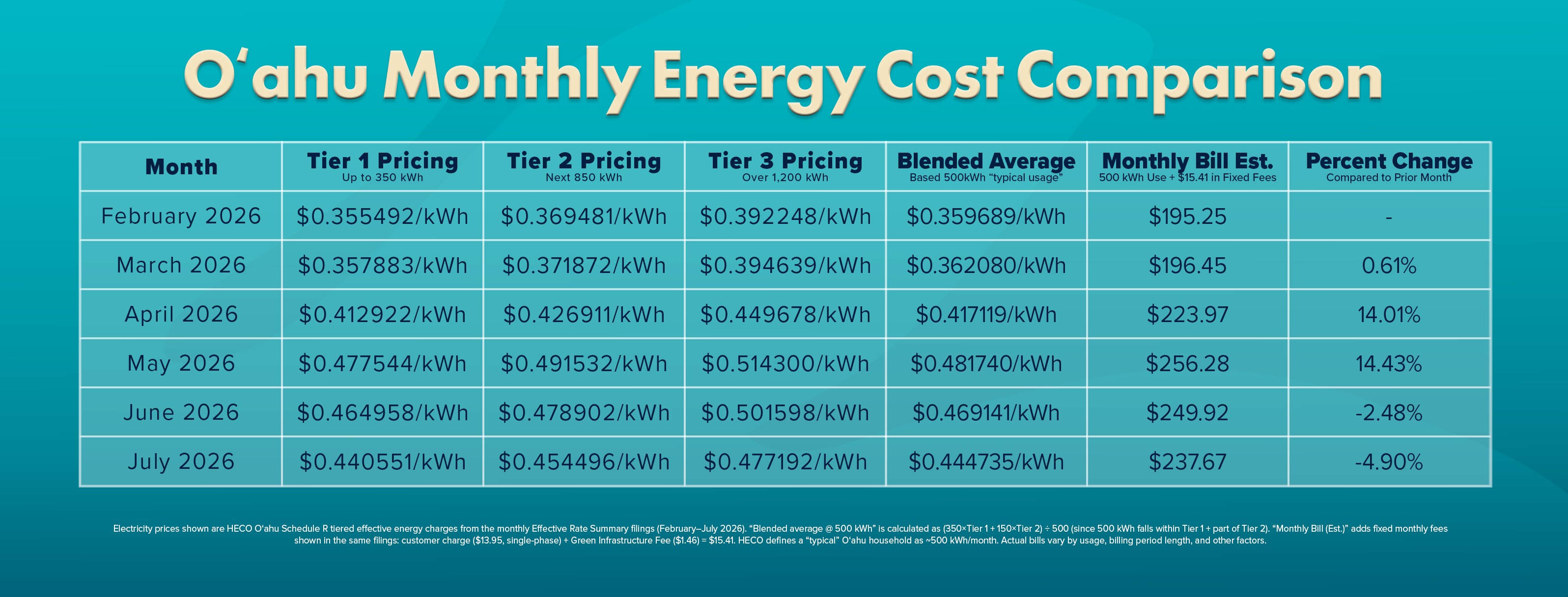
From February to July, the estimated 500 kWh bill is still up about $42.41, or roughly 21.70%.
That’s why we’re continuing to track this. Month-to-month relief helps, but the broader increase still matters for local households trying to manage their budgets.
What you can do next
If higher electric costs have you thinking more seriously about home energy upgrades, you’re not alone.
There are a few directions worth exploring depending on your home, budget, and what’s driving your usage:
- Cooling: If A/C is one of your biggest household energy uses, choosing the right type of unit and using it efficiently can make a difference.
- Water heating: Traditional electric tank water heaters can use a lot of electricity. Heat pump water heaters, solar water heating, and other options may be worth comparing.
- Appliances: Older appliances can quietly add to your monthly energy use, especially refrigerators, washers, dryers, and window A/C units.
- Solar + storage: For some homes, solar and battery storage may help reduce reliance on grid electricity, though the upfront cost and home fit are important considerations.
We’ve been building out the Lōkahi Energy Hub to bring these topics together in one place, with practical guides, local resources, and examples that make sense for Hawaiʻi homes.
Thinking about an energy-saving upgrade?
If you have a project in mind — even if you’re still in the “maybe” stage — we’re here to help you talk it through and run the numbers.
A few options that may fit, depending on the project:
- Solar + Energy Storage: our Eco-Personal Loan may help with eligible installation costs.
- Replacing an older appliance: our EcoSmart Appliance Loan may help with eligible energy-saving upgrades, including certain appliances and home efficiency improvements.
- For larger home projects: for eligible homeowners, a HELOC may be a flexible option for improvements that do not fit neatly into one category.
To learn more, call us at 808.440.5380 or stop by a branch. We’ll help you compare options and figure out what may fit your home and budget.
Disclosures
This article and any related infographic are intended to show month-to-month price trends using a consistent benchmark. The comparison above uses HECO Oʻahu Residential Schedule R published effective rates and a 500 kWh monthly usage example. Actual bills vary based on usage, billing period length, rate schedule, taxes, fees, and other bill components.
All loans are subject to qualifications and approval. Certain terms and conditions apply. Lōkahi FCU membership required. Federally insured by NCUA. Equal Housing Lender. NMLS #421418.
Data source + definitions
Hawaiian Electric publishes a monthly “Effective Rate Summary” that reflects rate schedule rates plus approved adjustments. The tiered prices used in this tracker are HECO Oʻahu Schedule R residential effective energy charges from the monthly Effective Rate Summary filings.
Typical usage benchmark:
This comparison uses 500 kWh/month as the Oʻahu household benchmark referenced in prior HECO-related tracker content.
Blended average calculation:
Because 500 kWh falls within Tier 1 plus part of Tier 2, the blended rate is calculated as:
Blended $/kWh @ 500 = monthly bill estimate ÷ 500
The monthly bill estimate includes:
350 kWh × Tier 1 + 150 kWh × Tier 2 + customer charge + Green Infrastructure Fee
Tier 3 note:
Tier 3 is shown in the tracker for context, but it does not affect the 500 kWh estimate because Tier 3 applies only to usage above 1,200 kWh/month under HECO Oʻahu Schedule R.
Data Sources:
Hawaiian Electric Effective Rate Summary landing page
February 2026 Effective Rate Summary
March 2026 Effective Rate Summary
April 2026 Effective Rate Summary
May 2026 Effective Rate Summary