
Start Here
This infographic is meant to provide an easy visual comparison of the four common AC systems in Hawaiʻi. As you review the chart, please keep in mind that these figures are approximations using available EnergyGuide® data and Hawaiian Electric Residential R rates.
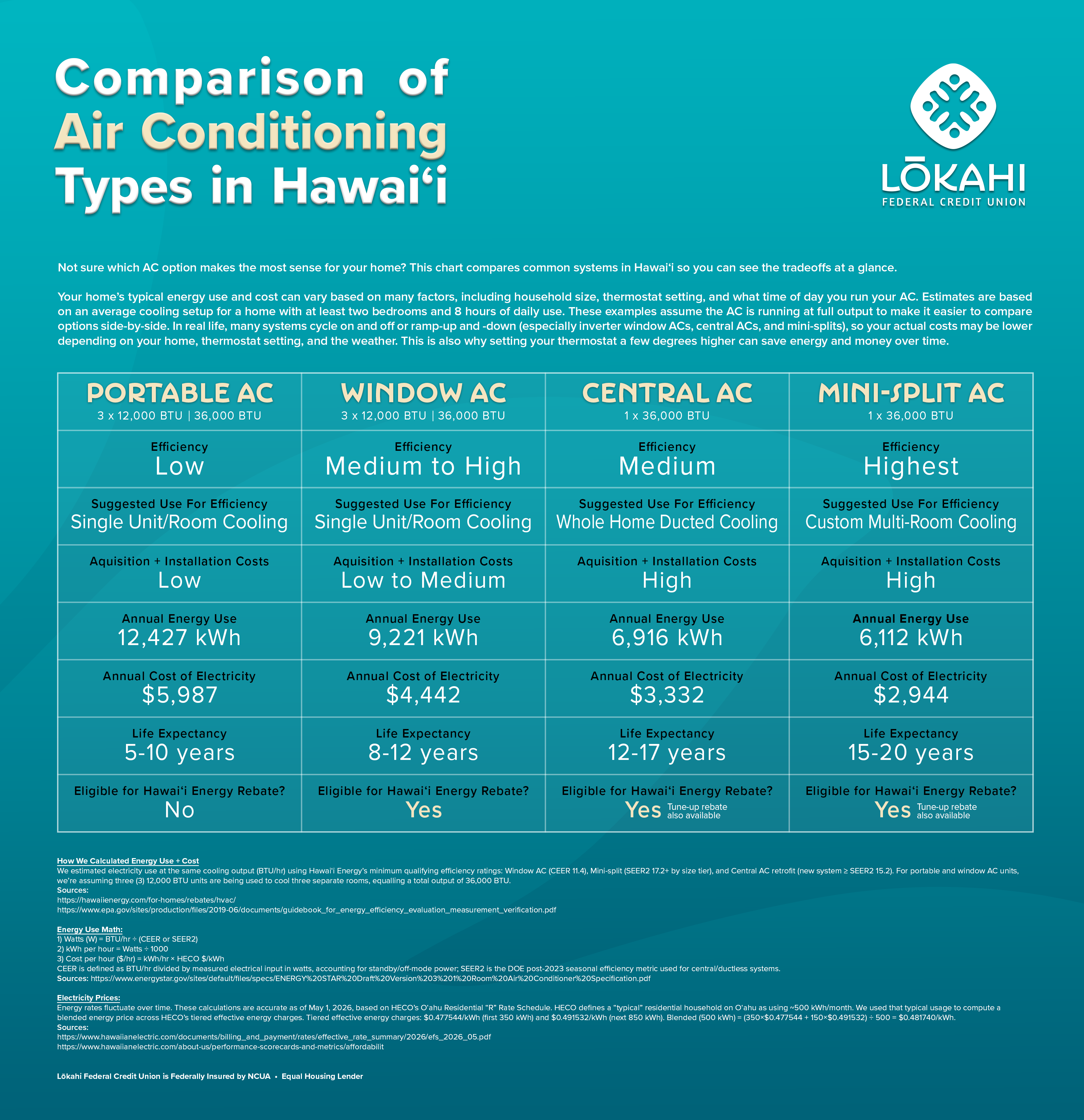
(click infographic to enlarge)
An Overview of Each AC Type
Portable AC
Portable ACs are best for when a window unit won’t work, such as if you rent, have non‑standard windows, or when you need something that you can move. They cool by pulling in warm air and venting hot air outside through a hose and window kit or other vent path, so setup matters for performance.
If you need flexibility, a portable AC might be the best fit for you. However, be aware that they can be louder (because the compressor is inside of the room with you), take up floor space, may collect condensation internally that must be emptied periodically, and can have a higher operating cost potential than window units, especially single hose models.
Window AC and Through-Wall Units
One of the most budget‑friendly ways to cool a single room, window ACs are one of the most common types in Hawaiʻi. They’re also an evolving cooling option, with two main types available today: traditional window units that run fully on or off, and newer inverter types that have variable-speed compressors that can adjust their output. Regardless of which type you choose, window AC units offer lower acquisition and installation costs, especially since most homes can install them with little to no modifications.
However, window AC units won’t work with all window types, including jalousies, and are still a noisier option since the entire system is housed in a single unit. They can also block light and views, and may limit or eliminate your use of the window it’s installed in. Though, ENERGY STAR® notes that u-shaped or saddle designs can reduce noise and may allow the window to open and close.
Traditional types also tend to be less efficient because of their fully on and off operation. Inverter types can be more efficient, quieter, and more comfortable, since they can adjust their output.
Central AC
Central AC is “whole‑home cooling” through ductwork and vents. They provide a clean look indoors since cooling comes through small vents rather than room units and can be relatively quiet indoors because the compressor is outside.
However, efficiency can take a big hit due to duct losses. According to ENERGY STAR®, 20% to 30% of air moving through ducts can be lost due to leaks, holes, and poor connections, while insufficient insulation can further impact efficiency. Room-to-room comfort also depends on airflow balance, which can be more difficult to control than with other AC types.
For homeowners that have this type of system, and have one that’s 10-15 years old, upgrading to a newer central AC can save up to 50% on cooling costs.
Mini-Split
Mini‑splits are another “whole-home cooling” option, though they give you better multi-room control and efficiency. That’s because, instead of pushing air through ductwork like with central AC, mini-splits send refrigerant through small, insulated tubing from its outdoor unit to an indoor unit(s). This means that cooling happens right in the space and gives your room-level control. Many use inverter technology to scale output for comfort and efficiency.
Of course, unlike central AC systems, mini-splits have more a visual impact. However, newer “hybrid” systems allow you to use a hidden air handler with short ducts to achieve the same look as a central AC system, but with less efficiency loss risk. You can even mix and match these hybrid options with traditional indoor units.
Regardless of how you choose to install a mini-split system, they are one of the more expensive options around, second only to a central AC.
Shopping Tip
When you’re comparing ACs, make sure you’re comparing the right efficiency rating for the system type. For portable and window AC, look for CEER on the EnergyGuide® label, higher numbers are better. For central AC and mini-splits, you’ll typically see SEER2 (and sometimes EER2/HSPF2 on heat pump systems). Again, like with CEER ratings, the higher the number, the better. If you’re deciding between two similar models, choosing the higher-rated unit can help lower operating cost over time, and it can also help with rebate eligibility when available.
Rebates + Project Financing
Rebates: Hawaiʻi Energy may offer rebates for qualifying upgrades, including certain window ACs, mini‑splits, AC tune‑ups, and some central AC retrofits. Eligibility and funding can vary, check out currently available rebates at hawaiienergy.com
Project financing: If you’re planning an energy‑saving upgrade and want to spread out the cost, we can help. Give us a call at 808.440.5380 and we’ll talk story through what you’re trying to do (one room, a few rooms, or a bigger project) and what financing approach might make sense. You may also explore our various options at here on our website, including our EcoSmart Appliance Loan.
Disclaimer
This content is for general informational purposes only and should not be relied upon as a guarantee of savings, performance, or eligibility. Information is believed to be accurate as of May 12, 2026, but is subject to change. Actual results vary; verify current rates, program requirements, and rebate availability with the appropriate providers.
All loans are subject to qualifications and approval. Certain terms and conditions apply. Lōkahi FCU membership required.
U-shaped / saddle window units: ENERGY STAR® notes that some ENERGY STAR®- certified room air conditioners use a U-shaped or saddle design that can reduce indoor noise and may allow the window to open/close more normally because the compressor sits outside. Source: [1]
Ductwork note (Central AC): ENERGY STAR® states that in a typical home, about 20%–30% of the air that moves through a duct system can be lost due to leaks, holes, and poorly connected ducts; this can affect comfort and energy costs. Source: [2]
Central AC upgrade savings claim: Hawaiʻi Energy notes that replacing an older central air conditioner with a qualifying system can use 30–50% less energy. Source: [3]
Additional context: The U.S. Department of Energy notes that switching to high-efficiency air conditioners (and other actions to keep your home cool) could reduce energy use for air conditioning by up to 50%. Source: [4]
Efficiency labels vary by system type: Room/window units commonly reference CEER, while whole-home systems commonly use the SEER2/EER2/HSPF2 family metrics; check the label/specs for the specific product you’re considering. Sources: [5] [6]
Rebate references
Hawaiʻi Energy HVAC rebates overview (window AC rebates; general program context): [7]
Hawaiʻi Energy participating contractor guidance (central AC retrofit rebate; eligibility conditions): [8]
Hawaiʻi Energy mini-split rebate application (mini-split eligibility thresholds by size/efficiency): [9]