
If you’re looking for one home upgrade that fits a lot of Hawaiʻi living situations (single-family, townhome, even many condos) and can seriously cut electricity use, a heat pump water heater is a strong contender. Hawaiʻi Energy notes that heat pump water heaters are 3–4x more efficient than a conventional electric water heater. Plus, they currently offer instant, in-store rebates on qualifying models.
In this post, we'll cover:
- What a heat pump water heater is, and how it's different from a standard electric tank
- Provide a real-world cost-savings example from a member of our team
- Highlight what to check at home so you know if one will "fit" your space
- Current Hawai'i Energy rebates
What is a Heat Pump Water Heater?
A heat pump water heater (HPWH) is a storage tank water heater, much like the standard electric tank and gas tank water heaters many homes already have. However, unlike the two traditional tank water heaters mentioned, HPWH heat water differently.
Standard Electric Tank (Electric Resistance) Water Heater
Before we cover how a HPWH, let's talk about the electric water heater most Hawaiʻi residence have - a standard electric tank water heater. As its name suggest, this type of water heater uses electricity to heater water directly. Think of a toaster or an electric coil stove. These types of units work well, but it tends to use a lot of electricity, which isnʻt idea in high-cost electricity markets like Hawaiʻi.
Heat Pump Water Heater
While a heat pump water heater still uses electricity, it doesn't use it to create heat directly. Instead, HPWHs use electricity to move heat from the surrounding air into the tank water. Think of these units more like a refrigerator or air conditioner running in reverse. The U.S. Department of Energy (DOE) explains that because a HPWH moves heat instead of generating it directly, it can be three to four times more energy efficient than conventional electric resistance water heaters.
A Real Hawaiʻi Example From Our Team
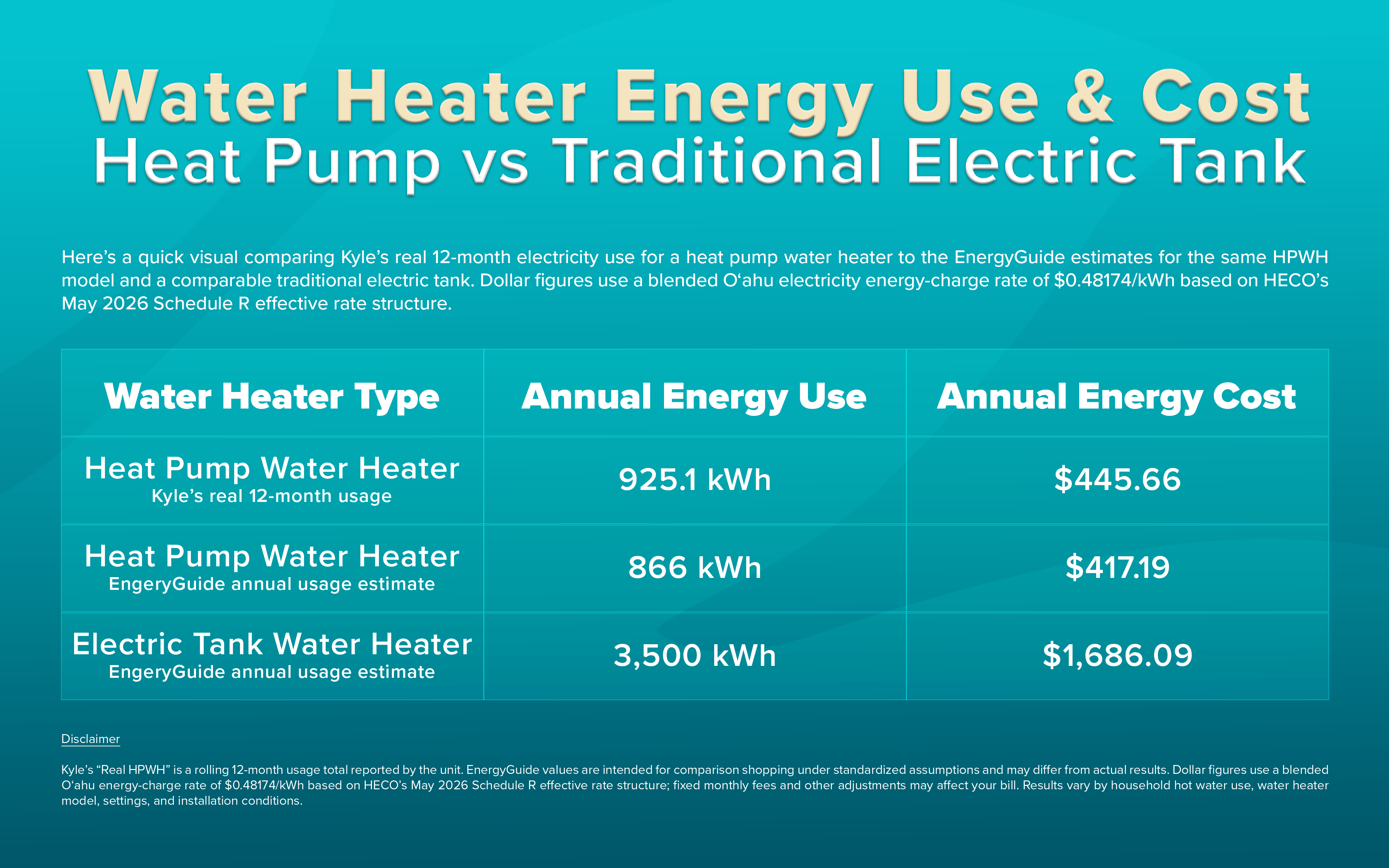
Kyle from our Marketing Department installed a 50-gallon-class heat pump water heater when he bough his townhome. The unit has built-in energy reporting, and it's rolling 12-month total showed 925.1 kWh of electricity use.

To make this comparison easier to understand, we put together an infographic that compares the his actual usage against EnergyGuide® estimate for his particular unit and a traditional resistive electric tank water heater. We then applied a blended-average Oʻahu energy-charge rate of $0.48174/kWh based on HECOʻs May 2026 Schedule R Effective rates and their 500 kWh "typical household" usage metric.
Breaking Down the Numbers
As you can see in the infographic, the 925.1 kWh used by Kyle HPWH equates to about $446 per year, which is slightly higher than the 886 kWh at $417 per year of the EnergyGuide® estimate. However, a standard resistive electric tank water heater would have used 3,500 kWh of electricity in a year, which equates to about $1,686 in energy charges.
In the above data, the HPWH energy use difference comes out to between 2,575 kWh to 2,634 kWh per year, which equates to a total energy-cost savings of $1,240 to $1,269 per year!
Why we like this comparison: EnergyGuide® labels are great for standardized comparisons, but it's also helpful to see a real "Hawai' household" data point alongside the test numbers.
Will a Heat Pump Water Heater Work in a Condo, Townhome, or Single-Family Home?
The good news is that HPWH, aside from being very efficient, are one of the most flexible water heating options around today. However, there are some important things to consider before you decide to convert to a HPWH.
- Airflow: HPWHs need enough surrounding air to pull heat from. The DOE notes that HPWHs need locations that stay roughly between 40º and 90ºF, which isn't usually an issue in Hawaiʻi. However, the DOE also states that HPWHs typically require about 1,000 cubic feet of air space around it (or alternatives like ducting. Here in the islands, that can mean putting your HPWH in a garage, covered lanai, utility area, or a closet with a louvered door or no door at all.
- Condensate Drain: As is the case with air conditioners, moving heat from the air can also pull moisture from it. This moisture condenses and needs to go somewhere, meaning you'll need to connect your HPWH to a drain line. Alternatively, you could have it drain into a bucket, though you'll need to remember to empty the bucket regularly.
- Ambient Impacts: A heat pump water heater can slightly cool the surrounding space as it transfers heat into the tank water (again, like an air conditioner in reverse). In a warm climate, that can be a small bonus, depending on where it's installed. However, beyond their cooling effect, HPWHs also emit noise akin to a window air conditioner. Most units are quieter, with noise ratings typically around 45 dBA to 55 dBA, which will often still be loud enough to hear in the next room over.
Current Hawaiʻi Energy Rebates for Heat Pump Water Heaters
Hawaiʻi Energy currently offers instant, in-store rebates on qualifying ENERGY STAR® heat pump water heater. This means that youʻll see the discounted reflected in the purchase price. As of the publication date of this post, these rebates are currently:
- $500 for 40-54 gallon size
- $700 for 55-82 gallon size
Eligibility details, including participating retailers/contractors and model requirements, can change at any time, so it's always worth double-checking Hawaiʻi Energy's program page before purchasing.
Why This Upgrade Can Be a Bid Deal in Hawaiʻi
As we all know, energy prices in Hawaiʻi are high and can fluctuate often with "effective rates" that include adjustments and surcharges (especially for fuel). So, when you upgrade something that runs daily like a water heater, the savings can compound quickly. This is especially true if youʻre replacing an older or less efficient electric tank water heater.
If the Upgrade Makes Sense... But the Upfront Costs Don't
If you're ready to upgrade to a heat pump water heater, but the upfront costs are the barrier, we're here to help. The Lōkahi FCU EcoSmart Appliance Loan is a type of loan that we developed just for projects like this. With EcoSmart, eligible applicants can finance the purchase of the unit, delivery, installation, and minor home improvements your installation may require.
Got an energy-saving project in mind and want to explore what options might be right for you? Drop by a branch or give us a call at 808.440.5380 to talk story. We're happy to help you think through your project and the various financing options available to you.
Disclosure / Sources
This message is provided for general informational and educational purposes only and is not financial, tax, legal, medical, or installation advice. Product selection and installation requirements vary—consult qualified professionals and follow manufacturer instructions and applicable building rules. Actual energy use, costs, and savings will vary based on household size, hot water use, temperature settings, installation location/airflow, and maintenance.
All loans are subject to qualifications and approval. Certain terms and conditions apply. Lōkahi FCU membership required.
Kyle Example Details: Kyle’s example reflects a heat pump water heater with built-in reporting (Rheem® model XE50T10H45U0) installed in an under-stair open closet/pantry area with the exhaust oriented toward the opening. The 925.1 kWh figure is the unit’s rolling 12-month electricity use as reported by the water heater. Kyle operates the unit in heat-pump-only mode with the tank set to 140°F and uses a thermostatic mixing valve to deliver approximately 125°F water at fixtures. Higher storage temperatures can increase scald risk; mixing controls can help manage delivered water temperature.
EnergyGuide® Comparison Assumptions: EnergyGuide® values are standardized estimates intended for comparison shopping under standardized test conditions and may not match real-world usage. The EnergyGuide® estimates shown in the infographic include (1) the EnergyGuide® estimate for Kyle’s HPWH model and (2) the EnergyGuide® estimate for a comparable traditional electric resistance tank from the same manufacturer (Rheem® model XE50T06ST45U1).
Rate Assumptions (Oʻahu): Dollar figures are illustrative and use a blended Oʻahu “energy-charge” rate of $0.48174/kWh calculated at 500 kWh/month using HECO’s May 2026 Schedule R effective rate structure. This blended energy-charge rate reflects tiered energy charges and does not include fixed monthly charges (such as the customer charge and green infrastructure fee) or other bill factors that may apply. Rates are current as of May 2026 / in accordance with HECO’s May 2026 rate schedule. For official rate schedules and the most up-to-date information, refer to Hawaiian Electric’s published materials, including the Effective Rate Schedule and your monthly bill.
Blended Average Calculation (500 kWh): Blended $/kWh @ 500 = (350×Tier 1 + 150×Tier 2) ÷ 500
Rebates: Hawaiʻi Energy rebate amounts, participating retailers/contractors, and eligibility requirements apply and may change. Rebate information is provided for convenience; members should confirm current details directly with Hawaiʻi Energy and participating retailers/contractors.
Trademark/Non-Endorsement: All trademarks, service marks, and product names (including Rheem®, ProTerra®, ENERGY STAR®, and EnergyGuide®) are the property of their respective owners and are used for identification and informational purposes only. No endorsement or affiliation is implied.